Molecular Weight: 349.434
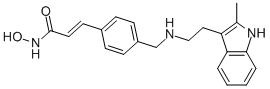
Molecular Formula: C21H23N3O2
Canonical SMILES: CC1=C(C2=CC=CC=C2N1)CCNCC3=CC=C(C=C3)C=CC(=O)NO
InChI: InChI=1S/C21H23N3O2/c1-15-18(19-4-2-3-5-20(19)23-15)12-13-22-14-17-8-6-16(7-9-17)10-11-21(25)24-26/h2-11,22-23,26H,12-14H2,1H3,(H,24,25)/b11-10+
InChIKey: FPOHNWQLNRZRFC-ZHACJKMWSA-N
Melting Point: 114-117?C
Purity: >98%
Solubility: In vitro:
10 mM in DMSO
Application: Antineoplastic Agents
Storage: Powder:
-20°C: 3 years
4°C: 2 years
In solvent:
-80°C: 6 months
-20°C: 1 month
Synonyms: LBH589; LBH 589; LBH-589; NVP-LBH589; NVP-LBH 589; Panobinostat; trade name Farydak
DescriptionPanobinostat is a cinnamic hydroxamic acid analogue with potential antineoplastic activity. Panobinostat selectively inhibits histone deacetylase (HDAC), inducing hyperacetylation of core histone proteins, which may result in modulation of cell cycle protein expression, cell cycle arrest in the G2/M phase and apoptosis. In addition, this agent appears to modulate the expression of angiogenesis-related genes, such as hypoxia-inducible factor-1alpha (HIF-1a) and vascular endothelial growth factor (VEGF), thus impairing endothelial cell chemotaxis and invasion. HDAC is an enzyme that deacetylates chromatin histone proteins.
More details are to be found on
supplier website